Descripción del Producto
Descripción del Producto
SWC BH Cardan Shaft Basic Parameter And Main Dimension
Cardan shaft is widely used in rolling mill, punch, straightener, crusher, ship drive, paper making equipment, common machinery, water pump equipment, test bench, and other mechanical applications.
Advantage:
1. Low life-cycle costs and long service life;
2. Increase productivity;
3. Professional and innovative solutions;
4. Reduce carbon dioxide emissions, and environmental protection;
5. High torque capacity even at large deflection angles;
6. Easy to move and run smoothly;
Detailed Photos
Product Parameters
| Model | Tn kN • m |
T. |
p (.) |
LS mm |
Lmin | Size mm |
I kg. m2 | m kg |
|||||||||||
| Di js11 |
d2 H7 |
Da | Lm | n-d | k | t | b h9 |
g | Lmin | 100mm | Lmin | 100mm | |||||||
| SWC58BH | 58 | 0.15 | 0.075 | ≤22 | 35 | 325 | 47 | 30 | 38 | 35 | 4-5 | 3.5 | 1.5 | – | – | – | – | 2.2 | – |
| SWC65BH | 65 | 0.25 | 0.125 | ≤22 | 40 | 360 | 52 | 35 | 42 | 46 | 4-6 | 4.5 | 1.7 | – | – | – | – | 3.0 | – |
| SWC75BH | 75 | 0.50 | 0.25 | ≤22 | 40 | 395 | 62 | 42 | 50 | 58 | 6-6 | 5.5 | 2.0 | – | – | – | – | 5.0 | – |
| SWC90BH | 90 | 1.0 | 0.50 | ≤22 | 45 | 435 | 74.5 | 47 | 54 | 58 | 4-8 | 6.0 | 2.5 | – | – | – | – | 6.6 | – |
| SWC100BH | 100 | 1.5 | 0.75 | ≤25 | 55 | 390 | 84 | 57 | 60 | 58 | 6-9 | 7 | 2.5 | – | – | 0.0044 | 0.00019 | 6.1 | 0.35 |
| SWC120BH | 120 | 2.5 | 1.25 | ≤25 | 80 | 485 | 102 | 75 | 70 | 68 | 8-11 | 8 | 2.5 | – | – | 0.5719 | 0.00044 | 10.8 | 0.55 |
| SWC150BH | 150 | 5 | 2.5 | ≤25 | 80 | 590 | 13.0 | 90 | 89 | 80 | 8-13 | 10 | 3.0 | – | – | 0.0423 | 0.00157 | 24.5 | 0.85 |
| SWC160BH | 160 | 10 | 5 | ≤25 | 80 | 660 | 137 | 100 | 95 | 110 | 8-15 | 15 | 3.0 | 20 | 12 | 0.1450 | 0.0060 | 68 | 1.72 |
| SWC180BH | 180 | 20 | 10 | ≤25 | 100 | 810 | 155 | 105 | 114 | 130 | 8-17 | 17 | 5.0 | 24 | 14 | 0.1750 | 0.0070 | 70 | 2.8 |
| SWC200BH | 200 | 32 | 16 | ≤15 | 110 | 860 | 170 | 120 | 127 | 135 | 8-17 | 19 | 5.0 | 28 | 16 | 0.3100 | 0.0130 | 86 | 3.6 |
| SWC225BH | 225 | 40 | 20 | ≤15 | 140 | 920 | 196 | 135 | 152 | 120 | 8-17 | 20 | 5.0 | 32 | 9.0 | 0.5380 | 0.5714 | 122 | 4.9 |
| SWC250BH | 250 | 63 | 31.5 | ≤15 | 140 | 1035 | 218 | 150 | 168 | 140 | 8-19 | 25 | 6.0 | 40 | 12.5 | 0.9660 | 0.5717 | 172 | 5.3 |
| SWC285BH | 285 | 90 | 45 | ≤15 | 140 | 1190 | 245 | 170 | 194 | 160 | 8-21 | 27 | 7.0 | 40 | 15.0 | 2.0110 | 0.571 | 263 | 6.3 |
| SWC315BH | 315 | 125 | 63 | ≤15 | 140 | 1315 | 280 | 185 | 219 | 180 | 10-23 | 32 | 8.0 | 40 | 15.0 | 3.6050 | 0.571 | 382 | 8.0 |
| SWC350BH | 350 | 180 | 90 | ≤15 | 150 | 1410 | 310 | 210 | 267 | 194 | 10-23 | 35 | 8.0 | 50 | 16.0 | 7.571 | 0.2219 | 582 | 15.0 |
| SWC390BH | 390 | 250 | 125 | ≤15 | 170 | 1590 | 345 | 235 | 267 | 215 | 10-25 | 40 | 8.0 | 70 | 18.0 | 12.164 | 0.2219 | 738 | 15.0 |
| SWC440BH | 440 | 355 | 180 | ≤15 | 190 | 1875 | 390 | 255 | 325 | 260 | 16-28 | 42 | 10 | 80 | 20.0 | 21.420 | 0.4744 | 1190 | 21.7 |
| SWC490BH | 490 | 500 | 250 | ≤15 | 190 | 1985 | 435 | 275 | 325 | 270 | 16-31 | 47 | 12 | 90 | 22.5 | 32.860 | 0.4744 | 1452 | 21.7 |
| SWC550BH | 550 | 710 | 355 | ≤15 | 240 | 2300 | 492 | 320 | 426 | 305 | 16-31 | 50 | 12 | 100 | 22.5 | 68.920 | 1.3570 | 2380 | 34 |
Packaging & Shipping
Company Profile
HangZhou CZPT Machinery Manufacturing Co., Ltd. is a high-tech enterprise specializing in the design and manufacture of various types of coupling. There are 86 employees in our company, including 2 senior engineers and no fewer than 20 mechanical design and manufacture, heat treatment, welding, and other professionals.
Advanced and reasonable process, complete detection means. Our company actively introduces foreign advanced technology and equipment, on the basis of the condition, we make full use of the advantage and do more research and innovation. Strict to high quality and operate strictly in accordance with the ISO9000 quality certification system standard mode.
Our company supplies different kinds of products. High quality and reasonable price. We stick to the principle of “quality first, service first, continuous improvement and innovation to meet the customers” for the management and “zero defect, zero complaints” as the quality objective.
Our Services
1. Design Services
Our design team has experience in Cardan shafts relating to product design and development. If you have any needs for your new product or wish to make further improvements, we are here to offer our support.
2. Product Services
raw materials → Cutting → Forging →Rough machining →Shot blasting →Heat treatment →Testing →Fashioning →Cleaning→ Assembly→Packing→Shipping
3. Samples Procedure
We could develop the sample according to your requirement and amend the sample constantly to meet your need.
4. Research & Development
We usually research the new needs of the market and develop new models when there are new cars in the market.
5. Quality Control
Every step should be a particular test by Professional Staff according to the standard of ISO9001 and TS16949.
FAQ
Q 1: Are you a trading company or a manufacturer?
A: We are a professional manufacturer specializing in manufacturing
various series of couplings.
Q 2:Can you do OEM?
Yes, we can. We can do OEM & ODM for all customers with customized PDF or AI format artwork.
Q 3:How long is your delivery time?
Generally, it is 20-30 days if the goods are not in stock. It is according to quantity.
Q 4: Do you provide samples? Is it free or extra?
Yes, we could offer the sample but not for free. Actually, we have an excellent price principle, when you make the bulk order the cost of the sample will be deducted.
Q 5: How long is your warranty?
A: Our Warranty is 12 months under normal circumstances.
Q 6: What is the MOQ?
A: Usually our MOQ is 1pcs.
Q 7: Do you have inspection procedures for coupling?
A:100% self-inspection before packing.
Q 8: Can I have a visit to your factory before the order?
A: Sure, welcome to visit our factory.
Q 9: What’s your payment?
A:1) T/T.
♦Contact Us
Web: huadingcoupling
Add: No.11 HangZhou Road,Chengnan park,HangZhou City,ZheJiang Province,China
/* May 10, 2571 16:49:51 */!function(){function d(e,r){var a,o={};try{e&&e.split(“,”).forEach(function(e,t){e&&(a=e.match(/(.*?):(.*)$/))&&1
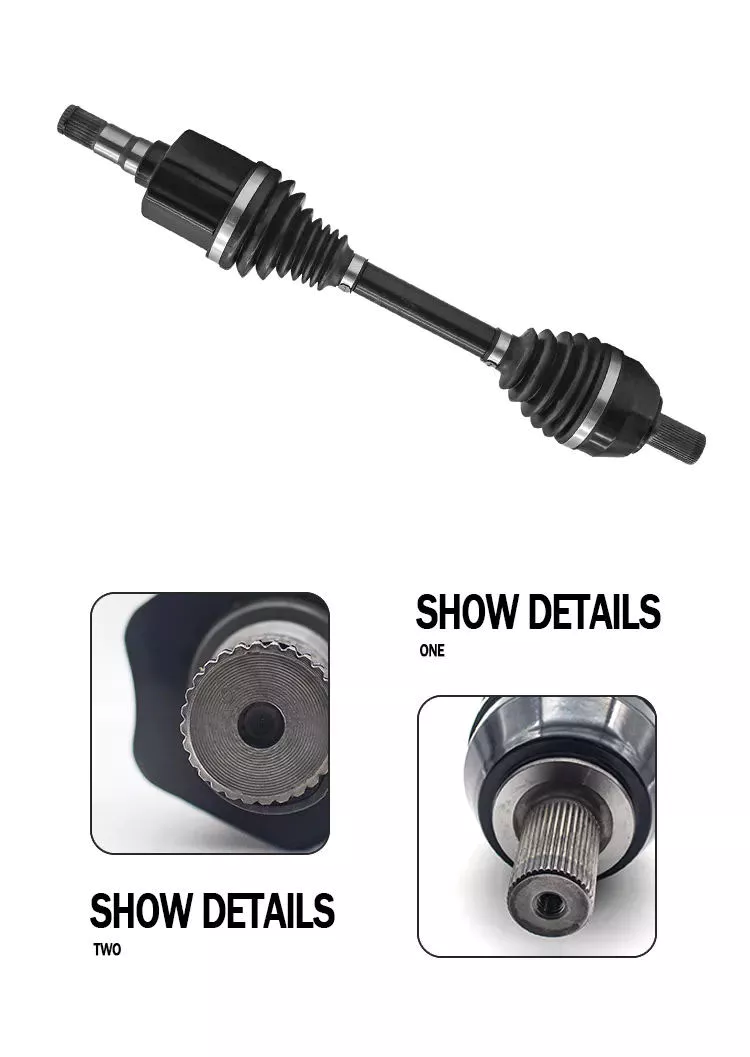
How do manufacturers ensure the compatibility of driveline components with different vehicles?
Manufacturers employ various measures to ensure the compatibility of driveline components with different vehicles. These measures involve careful design, engineering, testing, and standardization processes to meet the specific requirements of each vehicle type. Let’s explore how manufacturers ensure compatibility:
1. Vehicle-Specific Design:
Manufacturers design driveline components with specific vehicle types in mind. Each vehicle type, such as passenger cars, trucks, SUVs, or commercial vehicles, has unique requirements in terms of power output, torque capacity, weight distribution, space constraints, and intended usage. Manufacturers consider these factors during the component design phase to ensure that the driveline components are optimized for compatibility with the intended vehicle type.
2. Engineering and Simulation:
Manufacturers employ advanced engineering techniques and simulation tools to evaluate the performance and compatibility of driveline components. They use computer-aided design (CAD) software and finite element analysis (FEA) simulations to model and analyze the behavior of the components under various operating conditions. This allows them to identify any potential compatibility issues, such as excessive stress, misalignment, or interference, and make necessary design adjustments before moving to the production stage.
3. Prototyping and Testing:
Manufacturers create prototypes of driveline components and subject them to rigorous testing to ensure compatibility. These tests include bench testing, dynamometer testing, and vehicle-level testing. By simulating real-world operating conditions, manufacturers can evaluate the performance, durability, and compatibility of the components. They assess factors such as power transmission efficiency, torque capacity, heat dissipation, noise and vibration levels, and overall drivability to ensure that the components meet the requirements and are compatible with the intended vehicle.
4. Standardization:
Manufacturers adhere to industry standards and specifications to ensure compatibility and interchangeability of driveline components. These standards cover various aspects such as dimensions, material properties, spline profiles, shaft diameters, and mounting interfaces. By following established standards, manufacturers can ensure that their driveline components can be seamlessly integrated into different vehicles from various manufacturers, promoting compatibility and ease of replacement or upgrade.
5. Collaborative Development:
Manufacturers often collaborate closely with vehicle manufacturers during the development process to ensure compatibility. This collaboration involves sharing specifications, design requirements, and performance targets. By working together, driveline manufacturers can align their component designs with the vehicle manufacturer’s specifications, ensuring that the driveline components fit within the vehicle’s space constraints, mating interfaces, and intended usage. This collaborative approach helps optimize compatibility and integration between the driveline components and the vehicle’s overall system.
6. Continuous Improvement:
Manufacturers continuously improve their driveline components based on feedback, field data, and advancements in technology. They gather information from vehicle manufacturers, end-users, and warranty claims to identify any compatibility issues or performance shortcomings. This feedback loop helps drive refinements and enhancements in the design, manufacturing processes, and material selection of the driveline components, ensuring better compatibility and performance in future iterations.
Overall, manufacturers employ a combination of vehicle-specific design, engineering and simulation, prototyping and testing, standardization, collaborative development, and continuous improvement to ensure the compatibility of driveline components with different vehicles. These efforts help optimize power transmission, reliability, and performance, while ensuring a seamless integration of the driveline components into the diverse range of vehicles present in the market.

Can driveline components be customized for specific vehicle or equipment requirements?
Yes, driveline components can be customized to meet specific vehicle or equipment requirements. Manufacturers and suppliers offer a range of options for customization to ensure optimal performance, compatibility, and integration with different vehicles or equipment. Customization allows for tailoring the driveline components to specific powertrain configurations, operating conditions, torque requirements, and space constraints. Let’s explore the details of customization for driveline components:
1. Powertrain Configuration:
Driveline components can be customized to accommodate different powertrain configurations. Whether it’s a front-wheel drive, rear-wheel drive, or all-wheel drive system, manufacturers can design and provide specific components such as differentials, gearboxes, and drive shafts that are compatible with the required power distribution and torque transfer characteristics of the particular configuration.
2. Torque Capacity:
Driveline components can be customized to handle specific torque requirements. Different vehicles or equipment may have varying torque outputs based on their intended applications. Manufacturers can engineer and produce driveline components with varying torque-handling capabilities to ensure reliable and efficient power transmission for a range of applications, from passenger vehicles to heavy-duty trucks or machinery.
3. Size and Configuration:
Driveline components can be customized in terms of size, shape, and configuration to fit within the space constraints of different vehicles or equipment. Manufacturers understand that each application may have unique packaging limitations, such as limited available space or specific mounting requirements. Through customization, driveline components can be designed and manufactured to align with these specific dimensional and packaging constraints.
4. Material Selection:
The choice of materials for driveline components can be customized based on the required strength, weight, and durability characteristics. Different vehicles or equipment may demand specific material properties to optimize performance, such as lightweight materials for improved fuel efficiency or high-strength alloys for heavy-duty applications. Manufacturers can provide customized driveline components with materials selected to meet the specific performance and operational requirements.
5. Performance Optimization:
Driveline components can be customized to optimize performance in specific applications. Manufacturers can modify aspects such as gear ratios, differential configurations, or clutch characteristics to enhance acceleration, traction, efficiency, or specific performance attributes based on the intended use of the vehicle or equipment. This customization ensures that the driveline components are tailored to deliver the desired performance characteristics for the specific application.
6. Specialized Applications:
For specialized applications, such as off-road vehicles, racing cars, or industrial machinery, driveline components can be further customized to meet the unique demands of those environments. Manufacturers can develop specialized driveline components with features like enhanced cooling, reinforced construction, or increased torque capacity to withstand extreme conditions or heavy workloads.
Overall, customization of driveline components allows manufacturers to meet the specific requirements of different vehicles or equipment. From powertrain configuration to torque capacity, size and configuration, material selection, performance optimization, and specialized applications, customization ensures that driveline components are precisely designed and engineered to achieve the desired performance, compatibility, and integration with specific vehicles or equipment.
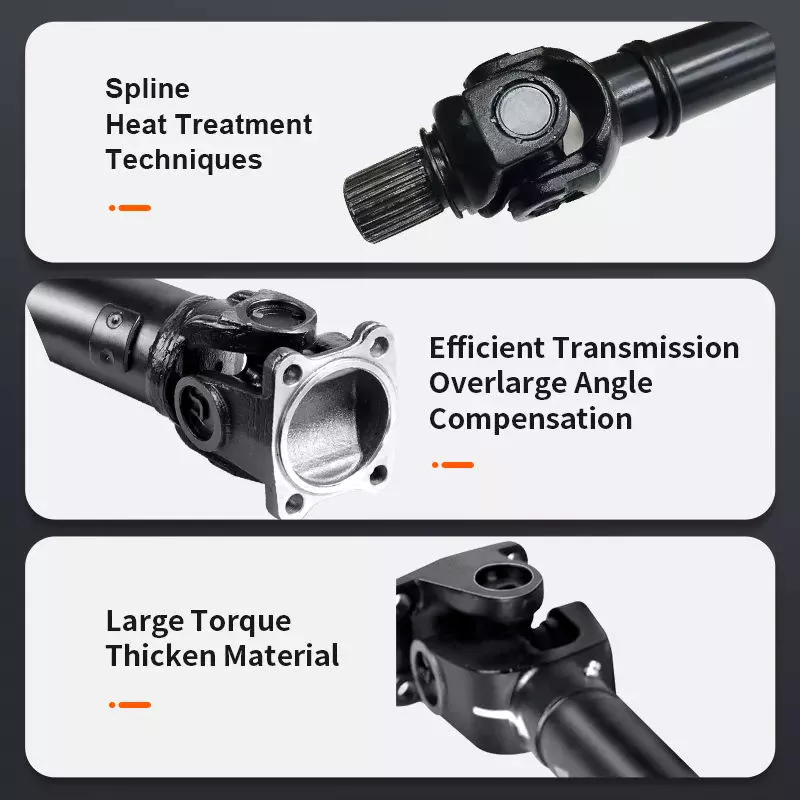
How do drivelines contribute to power transmission and motion in various applications?
Drivelines play a crucial role in power transmission and motion in various applications, including automotive vehicles, agricultural machinery, construction equipment, and industrial systems. They are responsible for transmitting power from the engine or power source to the driven components, enabling motion and providing the necessary torque to perform specific tasks. Here’s a detailed explanation of how drivelines contribute to power transmission and motion in various applications:
1. Automotive Vehicles: In automotive vehicles, such as cars, trucks, and motorcycles, drivelines transmit power from the engine to the wheels, enabling motion and propulsion. The driveline consists of components such as the engine, transmission, drive shafts, differentials, and axles. The engine generates power by burning fuel, and this power is transferred to the transmission. The transmission selects the appropriate gear ratio and transfers power to the drive shafts. The drive shafts transmit the power to the differentials, which distribute it to the wheels. The wheels, in turn, convert the rotational power into linear motion, propelling the vehicle forward or backward.
2. Agricultural Machinery: Drivelines are extensively used in agricultural machinery, such as tractors, combines, and harvesters. These machines require power transmission to perform various tasks, including plowing, tilling, planting, and harvesting. The driveline in agricultural machinery typically consists of a power take-off (PTO) unit, drive shafts, gearboxes, and implement shafts. The PTO unit connects to the tractor’s engine and transfers power to the drive shafts. The drive shafts transmit power to the gearboxes, which further distribute it to the implement shafts. The implement shafts drive the specific agricultural implements, enabling them to perform their intended functions.
3. Construction Equipment: Drivelines are essential in construction equipment, such as excavators, loaders, bulldozers, and cranes. These machines require power transmission to perform tasks such as digging, lifting, pushing, and hauling. The driveline in construction equipment typically consists of an engine, transmission, drive shafts, hydraulic systems, and various gear mechanisms. The engine generates power, which is transferred to the transmission. The transmission, along with the hydraulic systems and gear mechanisms, converts and controls the power to drive the different components of the equipment, allowing them to perform their specific functions.
4. Industrial Systems: Drivelines are widely used in industrial systems and machinery, including conveyor systems, manufacturing equipment, and heavy-duty machinery. These applications require power transmission for material handling, processing, and production. The driveline in industrial systems often involves electric motors, gearboxes, drive shafts, couplings, and driven components. The electric motor provides rotational power, which is transmitted through the driveline components to drive the machinery or conveyors, facilitating the desired motion and power transmission within the industrial system.
5. Power Generation: Drivelines are also employed in power generation applications, such as generators and turbines. These systems require power transmission to convert mechanical energy into electrical energy. The driveline in power generation often consists of a prime mover, such as an internal combustion engine or a steam turbine, connected to a generator. The driveline components, such as couplings, gearboxes, and drive shafts, transmit the rotational power from the prime mover to the generator, which converts it into electrical power.
6. Marine and Aerospace Applications: Drivelines are utilized in marine vessels and aerospace systems to facilitate propulsion and motion. In marine applications, drivelines transfer power from engines or turbines to propellers or water jets, enabling the vessel to move through the water. In aerospace applications, drivelines transmit power from engines to various components, such as rotors or propellers, providing the necessary thrust for flight.
In summary, drivelines are integral to power transmission and motion in a wide range of applications. They enable the transfer of power from the engine or power source to the driven components, allowing for the generation of torque and the performance of specific tasks. Drivelines play a vital role in automotive vehicles, agricultural machinery, construction equipment, industrial systems, power generation, and marine and aerospace applications, contributing to efficient power transmission, motion, and the overall functionality of these diverse systems.


editor by lmc 2024-11-08